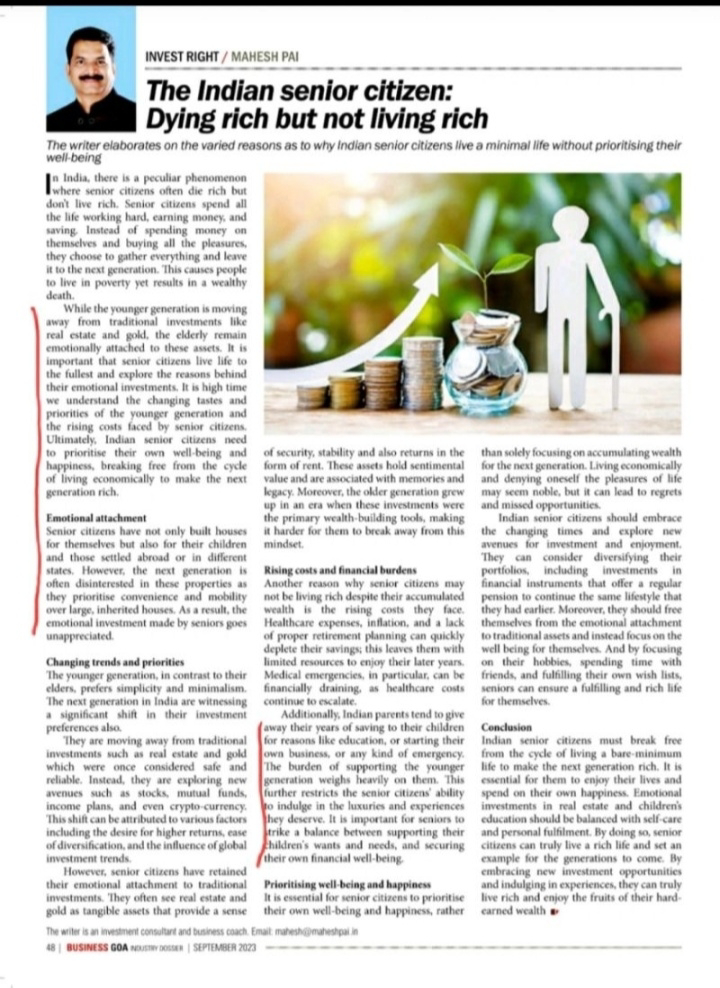
In the article “The Indian senior citizen: Dying rich but not living rich” by Mahesh Pai reproduced hereunder, he highlights:
- how many Indian seniors spend their lives saving and investing for the next generation, often denying themselves comfort and joy.
- Emotional attachment to property and traditional investments, rising healthcare costs, and outdated financial habits keep them away from living fully.
- urges seniors to prioritize their well-being, diversify investments, enjoy their resources, and embrace changing times — living meaningfully instead of merely accumulating wealth to leave behind.
To me:
Richness is not about the money we hold or hoard, but about living exuberantly with what we have.
Financial independence does matters — to live our old age with dignity, without depending on our children, physically or financially. In India, cannot depend on the Government also, despite we pay tax for earning and spending.
If we own far more than we ever need or use — and that’s okay. What matters is using what we have for our needs, not endless wants. Graciously give a little with those in need (beyond your family).
We will eventually leave everything behind when we go. Hold what you have lightly — attached while living, detached while giving and leaving.
Thus Live gratefully, Share graciously, Leave gracefully — is true richness.
Another Article
Synopsis
Break free from the scarcity mindset of hoarding and counting your money without using it. Be free of the self-imposed rule of passing on all that you have. Move away from the expectation that someone owes you your income, your earnings and your returns. Claim your space in the modern financial world—where you can invest by choice, manage cash on your terms, and spend or give as your heart desires.
Summary
1. Break the scarcity mindset. Stop hoarding money out of an automatic duty to “preserve” everything for heirs.
2. Accept market-driven interest rates. Government no longer guarantees high fixed returns; choose investments with that reality in mind.
3. Don’t assume you must be the perpetual provider. Today’s children often have better earning opportunities and may not need "full" parental inheritance.
4. Avoid living only on ‘safe’ interest. Relying solely on deposit interest traps retirees in unnecessary frugality.
5. Use (some of) your corpus. It’s legitimate to draw down a small portion of your capital each year to live well.
6. Free up illiquid wealth. Consider selling/monetizing underused assets (plots, ancestral homes, tiny flats) that earn negligible returns.
7. Make a clear inventory. List and revalue every asset in current market terms—bank balances, property, lockers, paper wealth.
8. Create a will.
9. Decide “use vs pass on.” Concretely allocate what you’ll enjoy now and what you’ll leave behind.
10. Invest the legacy for growth. Put the portion meant for heirs into growth assets (start modest equity exposure, e.g., 20% and scale up) to beat inflation.
11. Spend, give, and live on your terms. Draw down your earmarked funds gradually; enjoy everyday comforts and support causes you care about.
12. Own up a financial freedom, without guilt and obligation. Move away from entitlement thinking (like children owe them care or obedience just because they raised them; expecting their children to manage or inherit everything exactly as they wish) and manage money by choice—invest, spend, or give as your heart desires.
Especially the YouTube video
Comments
Post a Comment